Leadership takeaway: the experiment did not prove that software delivery is effortless. It showed that a small, well-governed team can reach decision-quality evidence far sooner.
Executive case study
Working MVPMapSpring: From dormant concept to working SaaS MVP in seven days.
AI-assisted engineering changes the economics of getting to evidence.
MapSpring demonstrates how human judgment, modern managed platforms, and AI-assisted implementation can compress the path from an unresolved concept to a credible, inspectable product.

Initial evidence checkpoint
A working product, measured through artifacts—not aspiration.
The initial checkpoint spans the first commit through the evidence package generated on May 9, 2026.
- Elapsed time from first commit to case-study checkpoint
- 7d 5h
- Commits across implementation, UX refinement, documentation, and evidence generation
- 84
- Source lines of code in the working product
- 8,510
- Markdown documents supporting governance, operations, and knowledge transfer
- 67
Source LOC counts implementation code. The documentation count covers tracked Markdown artifacts. Broader repository totals appear later and are intentionally not combined with these checkpoint measures.
Why it matters
Speed becomes valuable when it produces inspectable evidence.
Speed with evidence
The result was measured through working routes, commits, source code, documentation, screenshots, architecture, and deployment readiness—not through an isolated demonstration.
Operating model
AI served as an implementation multiplier while human judgment established positioning, architecture, risk tolerance, experience expectations, and quality thresholds.
Modern leverage
Next.js, Vercel, Supabase, managed authentication, PostgreSQL, and managed mapping services collapsed work that historically required multiple specialist roles.
The strategic advantage is not merely faster code. It is a shorter, less expensive path to informed investment decisions.
Origin
A useful idea waited for its delivery economics to change.
1998–1999 concept
Branch, ATM, and place-finding experiences were viable, but the delivery model was expensive and operationally demanding.
Modern cloud rebuild
Managed infrastructure, authentication, database services, APIs, and AI-assisted implementation made the concept practical to revive.
Focused SaaS positioning
The current product initially focuses on hosted branch and ATM locator experiences for credit unions.
| Dimension | Then | Now |
|---|---|---|
| Infrastructure | Dedicated hosting and operations | Managed deployment and data platforms |
| Specialization | Multiple infrastructure and application roles | Small human-led team with AI assistance |
| Release path | Manual, environment-heavy delivery | Repository checks and cloud deployment |
| Evidence | Long lead time before usable feedback | Working routes, code, documentation, and captures in one checkpoint |
This is a directional operating-model comparison, not a precise historical cost estimate.
What was built
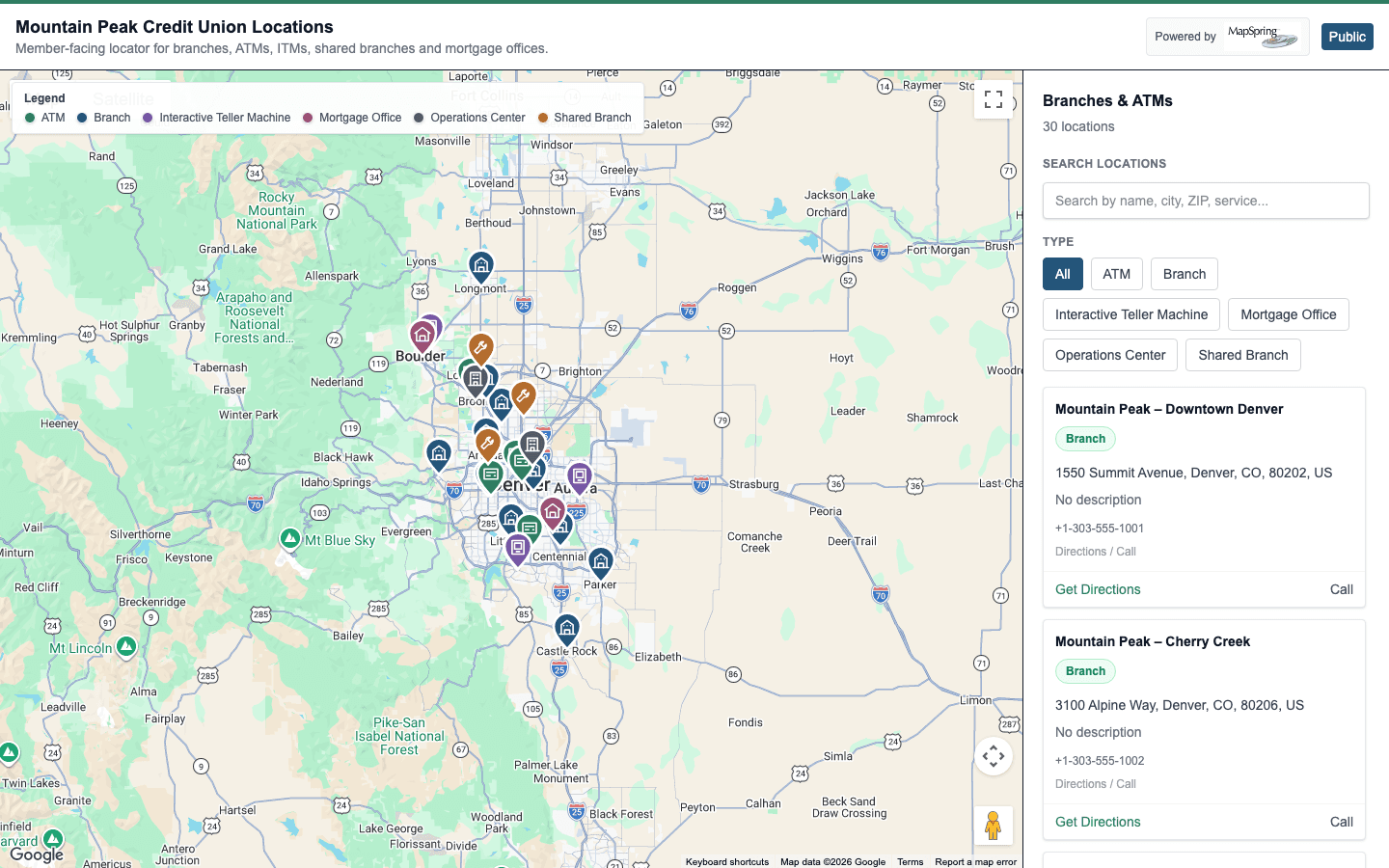
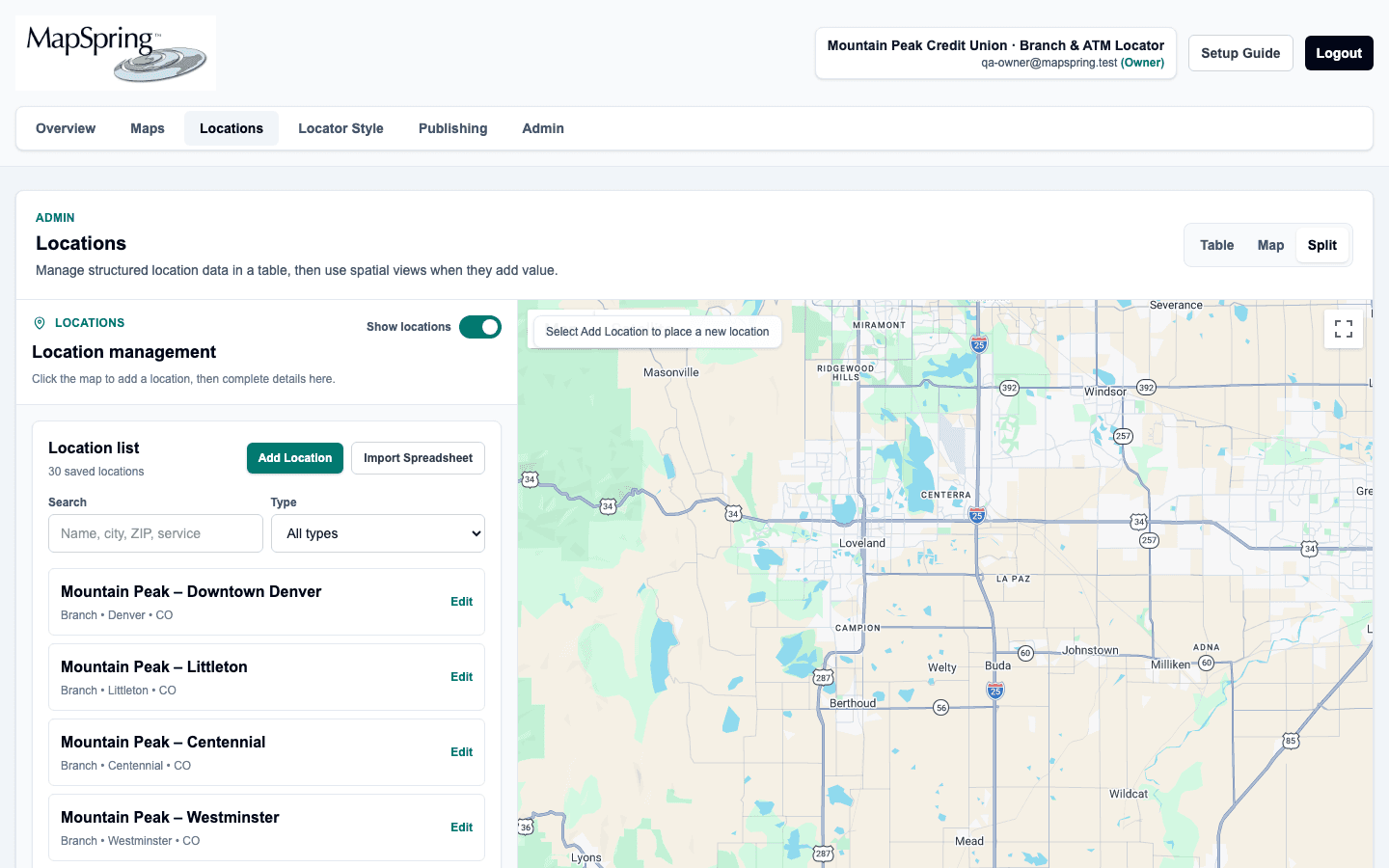
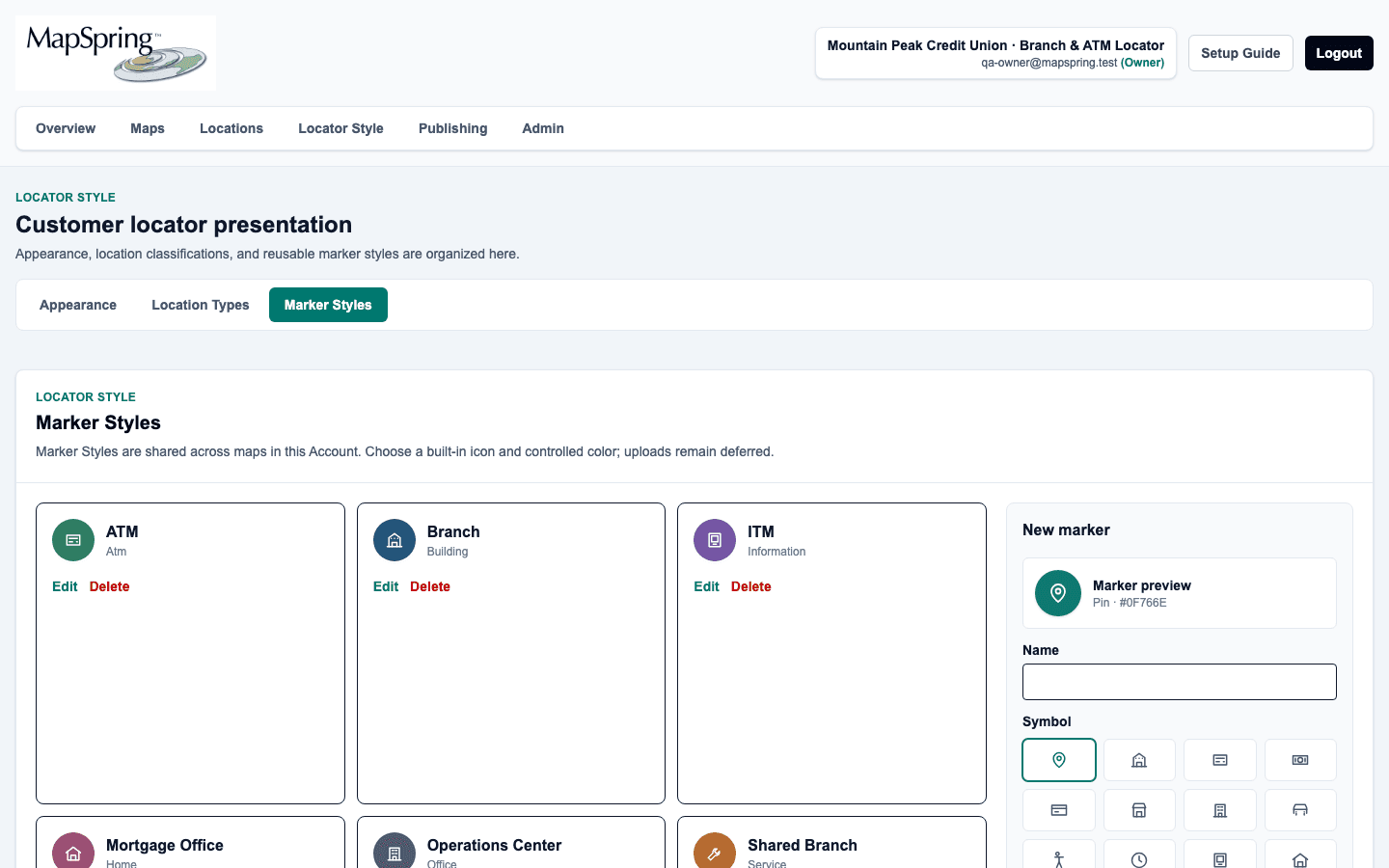
A working locator product with public, embedded, and authenticated surfaces.
The captures below come from the source-controlled checkpoint evidence package; loading-state limitations are labeled directly.


Available at checkpoint
Verified implementation capabilities—not a future roadmap.
- Public marketing homepage and onboarding entry point
- Supabase magic-link authentication and an authenticated workspace gateway
- Accounts, memberships, account-aware map workspaces, and role foundations
- Map and branch/ATM location management
- Private-by-default maps with publish and unpublish controls
- Public locator and separate iframe embed routes
- Search, location-type filtering, marker details, and directions links
- Map-scoped title, description, logo, primary color, and accent color
- RLS-backed public access limited to intentionally published map data
Repository evidence
The broader repository shows the system around the product.
- Total tracked lines, including configuration and structured data
- 15,927
- Tracked files in the repository
- 146
- Markdown documentation lines
- 5,557
- Primary public and authenticated routes documented at the checkpoint
- 7
Delivery model
Human judgment framed and verified the work; AI accelerated production.
- 1
Frame
- — Business positioning
- — User outcome
- — Acceptance criteria
- — Architecture boundaries
- — Risk constraints
- — Public versus authenticated behavior
- — Definition of credible evidence
- 2
Generate
- — Application code
- — Database migrations
- — UI refinements
- — Documentation
- — Checklists and route inventories
- — Architecture summaries and diagrams
- — Evidence packages
- 3
Review
- — Product credibility
- — Brand consistency
- — User experience
- — Authentication behavior
- — Architecture tradeoffs
- — Security and data-access implications
- — Public readiness and narrative quality
- 4
Verify
- — Lint and type checking
- — Production build
- — Route and authentication checks
- — Screenshot review
- — Repository analytics
- — Manual visual inspection
- — Deployment validation
Human judgment
- — Selecting credit unions as the initial market focus
- — Defining product positioning and MVP boundaries
- — Setting public versus authenticated route expectations
- — Determining brand credibility and professional polish
- — Choosing a lightweight architecture
- — Evaluating security and tenant-isolation implications
- — Resolving ambiguous product behavior
- — Accepting or rejecting evidence and public readiness
AI acceleration
- — Implementing changes across Next.js surfaces
- — Generating and modifying components
- — Producing database and configuration artifacts
- — Creating structured documentation and checklists
- — Building route and repository inventories
- — Drafting architecture summaries and diagrams
- — Supporting debugging and refactoring
- — Iterating after visual and UX feedback
- — Assisting evidence capture and synthesis
AI expanded implementation capacity. It did not assume accountability for product, architecture, security, or release decisions.
Architecture leverage
Managed platforms concentrated effort on product evidence.
User and member experience
Next.js App Router
- — Public homepage
- — Onboarding
- — Authenticated workspace
- — Public locator
- — Embedded locator
- — Application routing
Deployment edge
Vercel
- — Static and server rendering
- — Production builds
- — Environment-based deployment
- — Preview environments where configured
- — Simplified release model
Data and identity
Supabase
- — Magic-link authentication
- — PostgreSQL
- — Accounts and memberships
- — Maps and locations
- — Row-level security
- — Public and private access policies
Provider abstraction
Google Maps
- — Map presentation
- — Markers
- — Location interaction
- — Branch and ATM locator surfaces
- — Reduced provider coupling
Engineering pipeline
GitHub repository → automated checks → production build → Vercel deployment. Managed services reduced operational burden while preserving explicit application and data boundaries.
Security by architecture
Account and map-scoped data, private-by-default maps, publishing controls, and PostgreSQL row-level security establish the checkpoint foundation. Public queries are constrained to intentionally published map data.
Application checks complement—but do not replace—database policy. This is an implementation foundation, not a claim of complete enterprise security or compliance maturity.
Documentation as control
67 documents and 5,557 Markdown lines made the work inspectable.
Architecture summaries, operating guidance, route inventories, validation checklists, evidence definitions, and presentation materials supported review and knowledge transfer.
In an AI-assisted workflow, documentation is not post-project ceremony. It is a control surface for intent, verification, handoff, and accountable decision-making.
Lessons learned
Faster implementation raises the value of disciplined review.
Positioning matters early
Maintaining a focused credit-union value proposition while removing customer-identifiable demonstration content improved credibility.
Route behavior is part of the brand
Anonymous visitors needed a deliberate onboarding and sign-in experience rather than accidental exposure to an internal application surface.
Polish compounds trust
Logo consistency, hierarchy, publishing workflows, mobile behavior, and workspace organization materially changed perceived maturity.
Documentation is a control surface
Operating guides, checklists, architecture summaries, and screenshots made the work more inspectable, transferable, and governable.
Speed magnifies design decisions
AI can rapidly propagate both good and bad patterns. Clear architecture and conventions matter more when implementation velocity increases.
Verification becomes more important
Faster artifact generation increases the importance of build validation, route checks, security review, visual inspection, and explicit acceptance criteria.
Quality and governance
The checkpoint established foundations—not a complete enterprise operating framework.
Access control
Authentication guards, row-level security, and public/private route separation must be tested continuously.
Quality gates
Lint, type checking, production builds, route validation, and screenshot review should be minimum acceptance gates.
Brand and data provenance
Legacy assets, source content, customer-identifiable information, and AI-generated materials require deliberate ownership and review.
Operational ownership
Generated documentation can accelerate readiness, but accountable owners must maintain runbooks, environments, releases, and incident response.
Security posture
Managed platforms reduce infrastructure burden but do not eliminate responsibility for policy design, secrets, configuration, dependency risk, or access review.
Change management
Organizations need explicit standards for when AI-generated work is accepted, revised, escalated, or blocked.
Strategic implications
Fund evidence sooner, then scale what survives review.
Portfolio experiments
Shorten the path from dormant idea or unresolved problem to observable evidence before committing full-scale funding.
Architecture platforms
Invest in paved roads for authentication, hosting, data, APIs, observability, design systems, and deployment.
Review capability
Train leaders and engineers to specify, inspect, test, and verify AI-generated work. Review quality becomes a limiting factor as implementation capacity expands.
Economic governance
Use short evidence packages to decide whether to fund, pause, redirect, or scale an initiative.
The seven-day result is an initial evidence checkpoint. It does not replace lifecycle engineering, ongoing operations, security hardening, adoption work, or commercial validation.
Executive conclusion
AI-assisted engineering changes the economics of getting to evidence.
MapSpring produced working product surfaces, an inspectable architecture, a governed delivery record, and decision-quality evidence in one initial checkpoint—while keeping human accountability explicit.